Pulles Old Flute Out of Storage How to Prepare to Play Again
| Mellotron | |
|---|---|
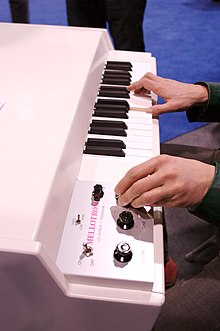 A Mellotron Mk Six | |
| Manufacturer | Bradmatic/Mellotronics (1963–lxx) Streetly Electronics (1970–86, 2007–present) |
| Dates | 1963 (Mk I) 1964 (Mk Two) 1968 (M300) 1970 (M400) 2007 (M4000) |
| Technical specifications | |
| Polyphony | Full |
| Oscillator | Audio tape |
| Synthesis type | Sample-based synthesis |
| Input/output | |
| Keyboard | one or 2 x 35 note manuals (G2–F5) |
The Mellotron is an electro-mechanical musical instrument developed in Birmingham, England, in 1963. It is played by pressing its keys, each of which pushes a length of magnetic record against a capstan, which pulls it across a playback head. As the fundamental is released, the tape is retracted past a spring to its initial position. Unlike portions of the tape tin be played to admission different sounds.
The Mellotron evolved from the like Chamberlin, but could be mass-produced more than efficiently. The showtime models were designed for the home and contained a variety of sounds, including automatic accompaniments. Bandleader Eric Robinson and television personality David Nixon helped promote the first instruments, and celebrities such equally Princess Margaret were early on adopters. It was adopted by rock and pop groups in the mid to late 1960s. The Beatles used it on tracks including the hit unmarried "Strawberry Fields Forever" (1967). The Moody Dejection keyboardist Mike Pinder used it extensively on the band's 1967 album Days of Future Passed. The Mellotron became mutual in progressive rock, used by groups such every bit Rex Crimson and Genesis. Later on models, such as the bestselling M400, dispensed with the accompaniments and some sound selection controls so information technology could exist used by touring musicians. The instrument's popularity declined in the 1980s after the introduction of polyphonic synthesizers and samplers, despite high-contour users such every bit Orchestral Manoeuvres in the Night and XTC.
Production of the Mellotron ceased in 1986, but it regained popularity in the 1990s and was used by bands such equally Haven and Radiohead. This led to the resurrection of the original manufacturer, Streetly Electronics. In 2007, Streetly produced the M4000, which combined the layout of the M400 with the bank selection of earlier models.
Operation [edit]
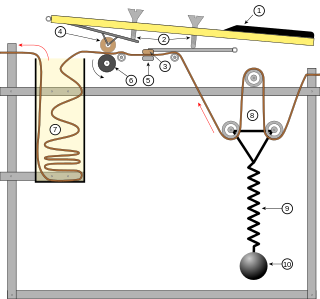
The internal operations of a Mellotron. Pressing a key (1), causes ii screws (two) to connect a pressure level pad (iii) with the tape head (5), and the pinch bicycle (iv) with the continuously rotating capstan (6). Tape is pulled at a gradual speed, balanced by a tension spring (8–10) and stored temporarily in a storage bin (vii) until the key is released.[one]
The Mellotron uses the same concept as a sampler, only generates its sound using counterpart samples recorded on audio tape rather than digital samples. When a key is pressed, a tape connected to it is pushed against a playback caput, as in a tape deck. While the central remains depressed, the tape is drawn over the head, and a sound is played. When the primal is released, a spring pulls the record back to its original position.[1]
A diverseness of sounds are available on the instrument. On earlier models, the instrument is divide into "lead" and "rhythm" sections. There is a choice of six "stations" of rhythm sounds, each containing three rhythm tracks and three make full tracks. The fill tracks tin also exist mixed together.[ii] : 17–eighteen Similarly, there is a choice of vi lead stations, each containing iii lead instruments which can be mixed. In the eye of the Mellotron, there is a tuning button that allows a variation in pitch (tempo, in the case of the rhythm tracks).[2] : nineteen Afterwards models practice not have the concept of stations and accept a single knob to select a sound, along with the tuning command. However, the frame containing the tapes is designed to exist removed, and replaced with one with dissimilar sounds.[3]
Although the Mellotron was designed to reproduce the audio of the original instrument, replaying a tape creates minor fluctuations in pitch (wow and flutter) and amplitude, so a annotation sounds slightly different each time information technology is played.[4] Pressing a key harder allows the caput to come up into contact under greater pressure level, to the extent that the Mellotron responds to aftertouch.[v]
Some other factor in the Mellotron'south sound is that the individual notes were recorded in isolation. For a musician accustomed to playing in an orchestral setting, this was unusual, and meant that they had nothing against which to intonate. Noted cellist Reginald Kirby refused to downtune his cello to encompass the lower range of the Mellotron, and and then the bottom notes are actually performed on a double bass. According to Mellotron author Nick Awde, 1 annotation of the cord sounds contains the audio of a chair beingness scraped in the background.[1]

The Mellotron M400 has a removable tape frame that can exist replaced with another containing unlike sounds
The original Mellotrons were intended to be used in the habitation or in clubs and were not designed for touring bands. Even the later M400, which was designed to be as portable equally possible, weighed over 122 pounds (55 kg).[6] Smoke, variations in temperature, and humidity were also detrimental to the musical instrument's reliability. Moving the musical instrument between cold storage rooms and brightly lit stages could cause the tapes to stretch and stick on the capstan. Leslie Bradley recalls receiving some Mellotrons in for a repair "looking like a blacksmith had shaped horseshoes on top".[7] Pressing too many keys at once caused the motor to drag, resulting in the notes sounding flat.[eight] Robert Fripp stated that "[t]uning a Mellotron doesn't".[nine] [10] Dave Kean, an expert Mellotron repairer, recommends that older Mellotrons should not be immediately used after a period of inactivity, every bit the record heads tin can become magnetised in storage and destroy the recordings on them if played.[7]
History [edit]

A Mellotron M400 tape frame equally removed from the instrument
Although tape samplers had been explored in inquiry studios, the first commercially available keyboard-driven tape instruments were congenital and sold by California-based Harry Chamberlin.[xi] The concept of the Mellotron originated when Chamberlin'south sales agent, Bill Fransen, brought two of Chamberlin'south Musicmaster 600 instruments to England in 1962 to search for someone who could manufacture 70 matching tape heads for future Chamberlins. He met Frank, Norman, and Les Bradley of tape engineering company Bradmatic Ltd, who said they could improve on the original design.[12] The Bradleys subsequently met bandleader Eric Robinson, who agreed to assistance finance the recording of the necessary instruments and sounds. Together with the Bradleys and television celebrity David Nixon, they formed a company, Mellotronics, in order to market the musical instrument.[13] Robinson was specially enthusiastic well-nigh the Mellotron, because he felt information technology would revitalise his career, which was so on the wane. He arranged the recording sessions at IBC Studios in London, which he co-owned with George Clouston.[14]
The first model to exist commercially manufactured was the Mk I in 1963. An updated version, the Mk II, was released the following year which featured the total set of sounds selectable past banks and stations.[12] The instrument was expensive, costing £1,000 (equivalent to $21,408 in 2020), at a time when a typical house toll £2,000–£iii,000.[15]
Fransen failed to explain to the Bradleys that he was not the owner of the concept, and Chamberlin was unhappy with the fact that someone overseas was copying his idea. Afterward some acrimony betwixt the 2 parties, a deal was struck between them in 1966, whereby they would both go along to manufacture instruments independently.[16] Bradmatic renamed themselves Streetly Electronics in 1970.[17]
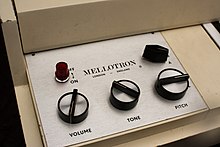
The simplified command console of the M400
In 1970, the model M400 was released, which contained 35 notes (G–F) and a removable tape frame. It sold over 1,800 units.[7] By the early 1970s, hundreds of the instruments were assembled and sold by EMI under exclusive licence.[8] Post-obit a financial and trademark dispute through a US distribution understanding, the Mellotron name was acquired by American-based Sound Sales.[18] Streetly-manufactured instruments after 1976 were sold under the proper name Novatron.[17] The American Mellotron distributor, Sound Sales, produced their ain Mellotron model, the 4-Rail, in the early 1980s. At the aforementioned time Streetly Electronics produced a road-cased version of the 400 – the T550 Novatron.[nineteen] By the mid-1980s, both Sound Sales and Streetly Electronics suffered severe fiscal setbacks, losing their market to synthesizers and solid-state electronic samplers, which rendered the Mellotron essentially obsolete. The company folded in 1986, and Les Bradley threw most of the manufacturing equipment into a skip.[20] From 1963 until Streetly'southward closure, around two,500 units had been built.[21]
Streetly Electronics was subsequently reactivated by Les Bradley's son John and Martin Smith.[22] After Les Bradley'south death in 1997, they decided to resume full-time operation as a back up and refurbishment concern. By 2007, the stock of available instruments to repair and restore was diminishing, and then they decided to build a new model, which became the M4000. The instrument combined the features of several previous models, and featured the layout and chassis of an M400 but with a digital banking company selector that emulated the mechanical original in the Mk Two.[3] [23]
Notable users [edit]

The first notable musician to use the Mellotron was variety pianist Geoff Unwin, who was specifically hired by Robinson in 1962 to promote the use of the musical instrument. He toured with a Mk II Mellotron and made numerous appearances on goggle box and radio.[24] Unwin claimed that the automatic backing tracks on the Mk II'south left-manus keyboard immune him to provide more than accomplished performances than his own bones skills on the piano could provide.[25]
The before 1960s Mk II units were made for the home and the characteristics of the instrument attracted a number of celebrities. Amid the early Mellotron owners were Princess Margaret,[26] Peter Sellers,[27] King Hussein of Jordan[15] and Scientology founder Fifty. Ron Hubbard[28] (whose Mellotron was installed in the Church of Scientology's head UK role at Saint Hill Manor).[29] Co-ordinate to Robin Douglas-Abode, Princess Margaret "adored information technology; (Lord Snowdon) positively loathed it".[27]
Subsequently Mellotronics had targeted them as a potential customer, the BBC Radiophonic Workshop became interested in the possibilities of the instrument, hoping it would permit them to increment throughput. The corporation used two custom-fabricated models that employed recorded sound effects throughout 1963 and 1964, merely had problems with fluctuating tape speed and constitute the audio wasn't upwards to professional broadcast quality.[30] The Mellotron was eventually dropped in favour of electronic oscillators and synthesizers.[31]
British multi-instrumentalist Graham Bond is considered the first stone musician to record with a Mellotron, beginning in 1965. The first hit vocal to characteristic a Mellotron Mk 2 was "Baby Can It Be True", which Bond performed alive with the machine in televised performances, using solenoids to trigger the tapes from his Hammond organ.[32] This was followed past Manfred Mann, who used its reed sound on their belatedly 1966 single "Semi-Detached Suburban Mr James".[33] The ring then included multiple Mellotron parts on their follow-up unmarried, "Ha! Ha! Said the Clown".[34]
There'south one matter I tin can practice /
Play my Mellotron for yous /
Try to blow away your city blues—Mike Pinder, "I Step Into the Light" on Octave [35]
Mike Pinder worked at Streetly Electronics for eighteen months in the early 1960s equally a tester, and was immediately excited past the possibilities of the musical instrument.[36] Afterwards trying piano and Hammond organ, he settled on the Mellotron as the instrument of selection for his ring, the Moody Blues, purchasing a 2nd-hand model from Fort Dunlop Working Men's Society in Birmingham[37] and using information technology extensively on every album from Days of Future Passed (1967) to Octave (1978).[38] Pinder says he introduced John Lennon and Paul McCartney to the Mellotron, and convinced each of them to purchase ane.[38] The Beatles hired a motorcar and used it on their single "Strawberry Fields Forever", recorded in various takes between November and Dec 1966.[39] [forty] Author Marking Cunningham describes the part in "Strawberry Fields Forever" every bit "probably the most famous Mellotron figure of all-fourth dimension".[41] Though producer George Martin was unconvinced past the instrument, describing it "as if a Neanderthal piano had impregnated a primitive electronic keyboard",[16] they continued to etch and record with diverse Mellotrons for the albums Magical Mystery Tour (1967)[42] and The Beatles (1968, besides known as "the White Album").[43] McCartney went on to utilise the Mellotron sporadically in his solo career.[44]
The musical instrument became increasingly popular among stone and pop bands during the psychedelic era, adding what author Thom Holmes terms "an eerie, unearthly sound" to their recordings.[45] Brian Jones of the Rolling Stones played a Mellotron on several of his band's songs over 1967–68. These include "We Dearest You", where he used the instrument to create a Moroccan-sounding horn section,[46] "She'southward a Rainbow",[47] "2000 Light Years from Home"[21] and "Jigsaw Puzzle".[48]

The Mellotron became a fundamental instrument in progressive rock. King Crimson bought two Mellotrons when forming in 1969.[49] They were aware of Pinder's contributions to the Moody Blues and did not want to sound similar, but concluded there was no other way of generating the orchestral sound.[50] The instrument was originally played by Ian McDonald,[51] and after by Robert Fripp on McDonald's departure. Afterward fellow member David Cross recalled he did not particularly want to play the Mellotron, but felt that it was simply what he needed to practise as a member of the band.[52] Tony Banks bought a Mellotron from Fripp in 1971, which he claimed was previously used past Male monarch Ruby, to use with Genesis. He decided to arroyo the instrument in a different mode to a typical orchestra, using block chords, and later stated that he used it in the same manner every bit a synth pad on afterward albums.[53] His unaccompanied introduction to "Watcher of the Skies" on the anthology Foxtrot (1972), played on a Mk II with combined strings and contumely, became significant plenty that Streetly Electronics provided a "Watcher Mix" audio with the M4000.[3] Banks claims to even so have a Mellotron in storage, but does not feel inclined to use it every bit he generally prefers to apply upwardly-to-date engineering science.[54] Barclay James Harvest's Woolly Wolstenholme bought an M300 primarily to use for string sounds,[55] and connected to play the musical instrument live into the 2000s as part of a reformed ring.[56]
Rick Wakeman played Mellotron on David Bowie'southward 1969 hit song "Space Oddity". Having previously found information technology difficult to continue in tune, Wakeman had discovered a mode to do so using a special fingering technique.[57]
The Mellotron was used past High german electronic band Tangerine Dream through the 1970s,[58] on albums such equally Atem (1973),[58] Phaedra (1974),[59] Rubycon (1975),[lx] Stratosfear (1976),[61] and Encore (1977).[61] In the late 1970s, French duo Space Fine art used a Mellotron during the recording of their second anthology, Trip in the Heart Caput.[62] In 1983, the band's Christopher Franke asked Mellotronics if they could produce a digital model, as the group migrated towards using samplers.[63]
Though the Mellotron was not extensively used in the 1980s, a number of bands featured it equally a prominent musical instrument. One of the few UK post-punk bands to do and so was Orchestral Manoeuvres in the Night, who featured it heavily on their platinum-selling 1981 album Compages & Morality. Andy McCluskey has stated they used the Mellotron because they were starting to run across limitations of the inexpensive monophonic synthesizers they had used upwards to that point. He bought a second-hand M400 and was immediately impressed with the strings and choir sounds.[64] XTC'due south Dave Gregory recalls seeing bands using Mellotrons when growing up in the 1970s, and idea it would be an interesting addition to the group's sound. He bought a 2nd-hand model in 1982 for £165, and first used it on the anthology Mummer (1983).[65] IQ'due south Martin Orford bought a second-hand M400 and used it primarily for visual entreatment rather than musical quality or convenience.[66]
The Mellotron resurfaced in 1995 on Oasis' album (What's the Story) Morning Glory? [67] The musical instrument was played by both Noel Gallagher and Paul Arthurs on several tracks, simply a particularly prominent use was the cello sound on the striking single "Wonderwall", played by Arthurs.[68] It too notably appears on their 2000 single Go Let It Out. Radiohead asked Streetly Electronics to restore and repair a model for them in 1997,[69] and recorded with information technology on several tracks for their album OK Computer (1997).[70] The French electronic duo Air extensively used a M400 on their two first albums Moon Safari in 1998 and The Virgin Suicides in 1999.[71]
Spock's Beard'due south Ryo Okumoto is a fan of the Mellotron, maxim it characterises the sound of the band.[72] Porcupine Tree's Steven Wilson has acquired one of King Crimson's old Mellotrons[73] and, in 2013, gave a sit-in of the instrument in celebration of its 50th anniversary.[74]
Competitors [edit]
Alternative versions of the Mellotron were manufactured by competitors in the early to mid-1970s. The Mattel Optigan was a toy keyboard designed to exist used in the abode, which played back sounds using optical discs.[75] This was followed by the Vako Orchestron in 1975, which used a more professional-sounding version of the same technology. It was popularised by Patrick Moraz.[76]
List of models [edit]
- Mk I (1963) – double manual (35 notes on each). Very like to the Chamberlin Music Main 600. About 10 were made.[nineteen]
- Mk II (1964) – double transmission. 18 sounds on each manual. Organ-manner cabinet, 2 12-inch internal speakers and amp. Weight 160 kg.[12] About 160 were fabricated.[nineteen]
- FX console (1965) – double manual with sound furnishings. Designed to exist quieter than the Mk Ii, with a different DC motor and a solid-land power amplifier.[8]
- M300 (1968) – 52-annotation single manual, some with pitch wheel-control, and some without. Virtually 60 were made.[19]
- M400 (1970) – 35-notation single manual. The virtually common and portable model. Most 1,800 units were made. It has 3 dissimilar sounds per frame.[12]
- EMI M400 (1970) – a special version of the M400 manufactured by EMI music visitor in Britain under licence from Mellotronics. 100 of this model were made.[8]
- Mark V (1975) – double-manual Mellotron, with the internals of two M400s plus boosted tone and command features.[8] Around nine were fabricated.[xix]
- Novatron Marking Five (1977) – the aforementioned equally the Mellotron Marker 5, just nether a different name.[19]
- Novatron 400 (1978) – every bit in a higher place; a Mellotron M400 with a different name-plate.[19]
- T550 (1981) – a flight-cased version of Novatron 400.[8]
- 4 Rails (1980) – very rare model; simply about five were ever made.[nineteen]
- Mark VI (1999) – an improved version of the M400. The outset Mellotron to exist produced since Streetly Electronics went out of concern in 1986.[8]
- Mark Vii – basically an upgraded Mark 5. Like the Mark VI, produced in the new factory in Stockholm.[77]
- Skellotron (2005) – an M400 in a transparent drinking glass example. Only ane was fabricated.[3]
- M4000 (2007) – ane manual, 24 sounds. An improved version of the Mk 2 with cycling mechanism. Made past Streetly Electronics.[3]
[edit]
- M4000D (2010) – a unmarried-transmission digital product that does not feature tapes. Made at the Mellotron factory in Stockholm.[77]
- Electro-Harmonix MEL9 Tape Replay Machine (2016) – simulator pedal
See likewise [edit]
- List of Mellotron recordings
- String synthesizer, another musical instrument used to imitate orchestral ensembles
References [edit]
- ^ a b c Awde 2008, p. 17.
- ^ a b Mellotron Mk II Service Manual (PDF). Streetly Electronics. Archived from the original (PDF) on eighteen December 2011. Retrieved 5 Nov 2013.
- ^ a b c d e Reid, Gordon (Oct 2007). "Streetly Mellotron M4000". Sound on Audio . Retrieved 2 September 2013.
- ^ Awde 2008, p. sixteen.
- ^ Vail 2000, p. 230.
- ^ Awde 2008, p. 23.
- ^ a b c Vail 2000, p. 233.
- ^ a b c d eastward f g Reid, Gordon (Baronial 2002). "Rebirth of the Absurd : The Mellotron Mk Six". Audio on Sound. Archived from the original on 27 September 2013. Retrieved 31 August 2013.
- ^ a b The Night Watch (Media notes). King Crimson. Discipline Global Mobile. 1997.
{{cite AV media notes}}: CS1 maint: others in cite AV media (notes) (link) - ^ Albiez, Sean; Pattie, David (2011). Kraftwerk: Music Not-Stop. Continuum. p. 129. ISBN978-1-4411-9136-six.
- ^ "The Chamberlin history". Clavia. Retrieved 17 August 2012.
- ^ a b c d "History of the Mellotron". Clavia. Archived from the original on v November 2012.
- ^ Awde 2008, pp. 44–46.
- ^ Awde 2008, pp. 64–66.
- ^ a b Shennan, Paddy (31 October 2008). "I gave Lennon a few rock tips". Liverpool Echo . Retrieved eight November 2013.
- ^ a b Brice 2001, p. 107.
- ^ a b Awde 2008, p. 44.
- ^ "Audio Sales brings Mellotron to the Usa". Music Trades. Music Trades Corporation. 126 (1–6): 69. 1978.
- ^ a b c d e f grand h Vail 2000, p. 232.
- ^ Awde 2008, p. 57.
- ^ a b Holmes 2012, p. 448.
- ^ Awde 2008, p. 33.
- ^ Awde 2008, p. 45.
- ^ Awde 2008, p. 59.
- ^ Awde 2008, p. 69.
- ^ Aronson, Theo (1997). Princess Margaret: A Biography. Regnery Pub. p. 231. ISBN978-0-89526-409-ane.
- ^ a b Lewis, Roger (1995). The life and expiry of Peter Sellers. Pointer. p. 939. ISBN978-0-09-974700-0.
- ^ Thompson, Andy. "Oddball Owners". Planet Mellotron. Retrieved 14 September 2012.
- ^ "Clients". Streetly Electronics. Archived from the original on 9 November 2013. Retrieved 8 November 2013.
- ^ Niebur 2010, p. 126.
- ^ Niebur 2010, p. 127.
- ^ Awde 2008, p. 91.
- ^ Semi-Detached, Suburban Mr. James (Mono Version) on YouTube
- ^ Cunningham 1998, pp. 126–27.
- ^ Pinder, Michael (1978). "One Stride Into The Light Lyrics". Octave. Archived from the original on 7 June 2017. Retrieved 16 October 2014 – via MetroLyrics.com.
{{cite spider web}}: CS1 maint: unfit URL (link) - ^ Awde 2008, pp. 88–89.
- ^ Awde 2008, p. 169.
- ^ a b Awde 2008, p. 94.
- ^ Everett 1999, p. 146.
- ^ Pinder, Mike. "Mellotron". Mike Pinder (Official Web Site). Archived from the original on 20 June 2007.
- ^ Cunningham 1998, p. 127.
- ^ Everett 1999, p. 247.
- ^ Everett 1999, p. 248.
- ^ Benitez, Vincent P. (2010). The Words and Music of Paul McCartney: The Solo Years. Santa Barbara, CA: Praeger. pp. 23, 47, 86, 139. ISBN978-0-313-34969-0.
- ^ Holmes 2012, pp. 448–49.
- ^ Davis, Stephen (2001). Sometime Gods Nearly Expressionless: The xl-Year Odyssey of the Rolling Stones. New York, NY: Broadway Books. pp. 209–ten. ISBN0-7679-0312-9.
- ^ Thompson, Gordon (2008). Please Please Me: Sixties British Popular, Inside Out. Oxford University Press. p. 301. ISBN978-0-195-33318-iii.
- ^ Clayson, Alan (2008). The Rolling Stones: Beggars Feast – Legendary sessions. Billboard Books. p. 246. ISBN978-0-823-08397-eight.
- ^ "Cerise's trons". Retrieved 19 March 2018.
- ^ Awde 2008, pp. 116–117.
- ^ Awde 2008, p. 118.
- ^ Awde 2008, p. 187.
- ^ Awde 2008, pp. 200–201.
- ^ Jenkins 2012, p. 246.
- ^ Awde 2008, p. 133.
- ^ Awde 2008, p. 148.
- ^ Rick Wakeman (8 Jan 2017). "The day I played the Mellotron for David Bowie". The Guardian . Retrieved v February 2017.
- ^ a b Stump 1997, p. 39.
- ^ Mera, Miguel; Burnand, David (2006). European Film Music. Ashgate Publishing. p. 129. ISBN978-0-7546-3659-5.
- ^ Stump 1997, p. 64.
- ^ a b Stump 1997, p. seventy.
- ^ Richard, Philippe (29 November 2016). "Musique. Space Art, pionniers de l'electro à la française" [Music. Space Fine art, pioneers of French electro]. Ouest France (in French). Retrieved 28 Apr 2021.
- ^ Stump 1997, p. 119.
- ^ Awde 2008, p. 401.
- ^ Awde 2008, p. 387.
- ^ Awde 2008, p. 455.
- ^ The Mojo Collection: fourth Edition. Canongate Books. 2007. p. 622. ISBN978-one-84767-643-six.
- ^ Buskin, Richard (November 2012). "Oasis "Wonderwall" : Classic Tracks". Audio on Sound . Retrieved 2 September 2013.
- ^ Etheridge, David (October 2007). "Mellotron M4000". Performing Musician. Archived from the original on iv November 2013. Retrieved 3 September 2013.
- ^ Letts, Marianne Tatom (2010). Radiohead and the Resistant Concept Anthology: How to Disappear Completely. Indiana University Press. p. 30. ISBN978-0-253-00491-8.
- ^ Thompson, Andy. "AIR". Planet Mellotron.
- ^ Jenkins 2012, p. 251.
- ^ Orant, Tony (twenty September 2013). "Adam Holzman straddles Prog Stone and Jazz Fusion". Keyboard Magazine . Retrieved 3 February 2014.
- ^ Blackmarquis, Philippe (30 October 2013). "Steven Wilson – review of the concert at the Depot in Leuven". Peek a Boo Magazine . Retrieved 3 February 2014.
- ^ Vail 2000, pp. 97–98.
- ^ Vail 2000, p. 97.
- ^ a b "Mellotron Mark VI, Marker VII, M4000D". Mellotron (official site). Retrieved 25 February 2014.
- Books
- Awde, Nick (2008). Mellotron: The Machines and the Musicians that Revolutionised Stone. Bennett & Blossom. ISBN978-1-898948-02-v.
- Brice, Richard (2001). Music Applied science. Newnes. ISBN978-0-7506-5040-3.
- Cunningham, Marking (1998). Practiced Vibrations: A History of Record Production. London: Sanctuary. ISBN978-1860742422.
- Everett, Walter (1999). The Beatles as Musicians: Revolver through the Anthology. Oxford University Press. ISBN978-0-19-802960-1.
- Holmes, Thom (2012). Electronic and Experimental Music: Technology, Music, and Civilization (4th edn) . New York, NY: Routledge. ISBN978-0-415-89636-8.
- Jenkins, Mark (2012). Analog Synthesizers: Understanding, Performing, Ownership – From the Legacy of Moog to Software Synthesis. CRC Press. ISBN978-1-136-12277-4.
- Niebur, Louis (2010). Special Sound: The Creation and Legacy of the BBC Radiophonic Workshop. Oxford Academy Press. ISBN978-0-19-536840-6.
- Stump, Paul (1997). Digital Gothic: A Critical Discography of Tangerine Dream. SAF Publishing Ltd. ISBN978-0-946719-18-1.
- Vail, Mark (2000). Keyboard Magazine Presents Vintage Synthesizers: Pioneering Designers, Groundbreaking Instruments, Collecting Tips, Mutants of Technology. Backbeat Books. ISBN978-0-87930-603-viii.
Further reading [edit]
- Radcliffe, Mark (iii June 2006). "Sampledelica! The History of the Mellotron". BBC Radio 4. BBC. Retrieved 5 November 2013.
- "The Mellotron". Music Technology. Vol. 3, no. 5. April 1989. p. 24. ISSN 0957-6606. OCLC 24835173.
External links [edit]
 | Wikimedia Eatables has media related to Mellotrons. |
- Mellotron.com – US manufacturers and trademark owners
- Mellotronics.com – Streetly Electronics, United kingdom manufacturers
- Planet Mellotron – Listing of Mellotron recordings and anthology reviews
- Mellotron Info – History and inner workings by self-confessed Mellyholic Norm Leete
- The Mellotron on '120 years Of Electronic Music'
- Eric Robinson & David Nixon demonstrate: The Mellotron (1965) | British Pathé
Source: https://en.wikipedia.org/wiki/Mellotron
0 Response to "Pulles Old Flute Out of Storage How to Prepare to Play Again"
Enregistrer un commentaire